
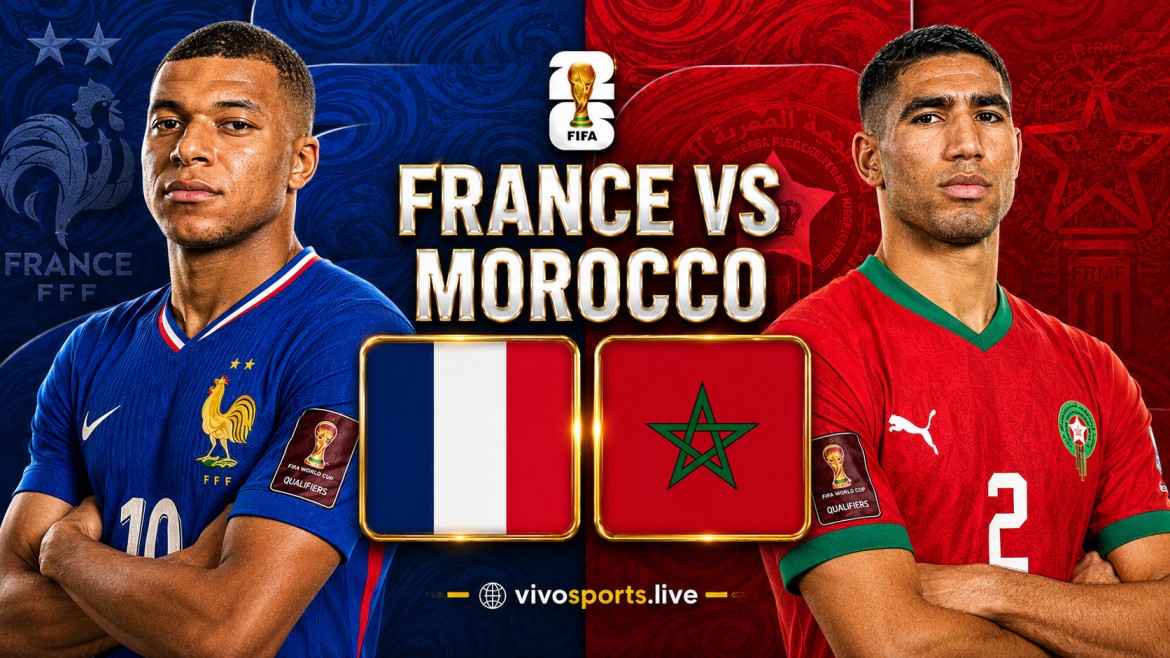
| France vs Morocco | |
| Match Details | |
| Match: | France vs Morocco |
| Tournament: | FIFA World Cup |
| Match Time: | 1:30 AM |
| Stadium: | Gillette Stadium, Foxborough, Massachusetts |
Preview: France vs Morocco
France and Morocco meet once again on the World Cup stage in a highly anticipated quarter-final clash, with a coveted place in the semi-finals up for grabs. Les Bleus arrive as one of the strongest contenders for the title after producing another convincing knockout performance, while Morocco continue to defy expectations with a remarkable campaign built on resilience, teamwork and tactical discipline. France possess one of the tournament's most talented squads, boasting world-class quality in every position, but Morocco have already proven throughout this World Cup that they are capable of competing with and defeating football's biggest nations. With both teams now just one victory away from the final four, this encounter promises to deliver another memorable chapter in their growing World Cup rivalry.
Didier Deschamps' side will look to impose their attacking style from the opening whistle, relying on quick ball circulation, midfield control and the explosive pace of Kylian Mbappé to break down Morocco's disciplined defence. Ousmane Dembélé and Michael Olise are expected to stretch the pitch from wide areas, while Aurélien Tchouaméni and Eduardo Camavinga provide balance and stability in midfield. Morocco, meanwhile, will remain faithful to the tactical identity that has brought them success throughout the tournament. Walid Regragui's men are likely to defend in a compact shape before launching dangerous counter-attacks through Achraf Hakimi, Brahim Díaz and Sofiane Rahimi. The battle between France's relentless attacking movement and Morocco's exceptional defensive organisation could ultimately decide which nation progresses to the semi-finals.
Head-to-Head
France and Morocco have faced each other several times over the years, with France holding the advantage in the overall head-to-head record. Their most memorable meeting came in the semi-finals of the 2022 FIFA World Cup, where France secured a 2-0 victory to end Morocco's historic run and advance to the final. That match showcased Morocco's resilience despite missing several key defenders, while France demonstrated their clinical finishing and experience on the biggest stage. Although many of their previous encounters have been international friendlies, every meeting between these two nations has been fiercely contested. Morocco will undoubtedly use the disappointment of their 2022 World Cup exit as extra motivation, while France will look to maintain their dominance and once again prove why they remain one of the world's elite footballing nations.
Tournament Performance
France have enjoyed another impressive World Cup campaign, progressing through the group stage with authority before comfortably defeating Paraguay in the Round of 16. Their attack has consistently produced goals, while the defence, led by William Saliba and Ibrahima Konaté, has remained composed under pressure. Kylian Mbappé has once again been the team's standout performer, supported brilliantly by Dembélé, Olise and Tchouaméni. Morocco, meanwhile, have continued to build on their reputation as one of international football's most disciplined teams. After an excellent group-stage campaign, they produced another outstanding defensive display to eliminate Canada and reach the quarter-finals. Led by captain Achraf Hakimi and midfield anchor Sofyan Amrabat, the Atlas Lions have combined defensive solidity with clinical counter-attacking football, making them one of the most difficult teams left in the tournament to break down.
France Possible XI
France Predicted Lineup (4-3-3): Mike Maignan; Jules Koundé, Ibrahima Konaté, William Saliba, Theo Hernández; Aurélien Tchouaméni, Eduardo Camavinga, Adrien Rabiot; Ousmane Dembélé, Kylian Mbappé, Michael Olise.
France are expected to stick with their attacking 4-3-3 formation, with Mbappé leading the frontline alongside Dembélé and Olise. Tchouaméni will anchor the midfield, while Saliba and Konaté provide defensive stability against Morocco's dangerous counter-attacking threat.
Morocco Possible XI
Morocco Predicted Lineup (4-3-3): Yassine Bounou; Achraf Hakimi, Nayef Aguerd, Chadi Riad, Noussair Mazraoui; Sofyan Amrabat, Azzedine Ounahi, Bilal El Khannouss; Brahim Díaz, Youssef En-Nesyri, Sofiane Rahimi.
Morocco are likely to continue with their disciplined 4-3-3 system, relying on Amrabat to shield the defence while Hakimi provides attacking width from right-back. En-Nesyri will spearhead the attack, with Brahim Díaz and Rahimi looking to exploit spaces on quick transitions.
FIFA World Cup 2026: A New Era in Global Football
The FIFA World Cup is the most prestigious and widely watched sporting event in the world. Since its inception in 1930, the tournament has brought together nations from every continent, creating unforgettable moments of sporting excellence, national pride, and cultural unity. As football fans around the globe eagerly anticipate the FIFA World Cup 2026, the upcoming tournament promises to be one of the most historic editions ever held. With an expanded format, three host nations, and record participation, the 2026 World Cup marks a significant milestone in the evolution of international football.
The history of the FIFA World Cup began in 1930 when the first tournament was organized in Uruguay. Only 13 teams participated, and Uruguay emerged as the inaugural champion. Over the decades, the competition grew rapidly in popularity and size. Legendary teams such as Brazil, Germany, Italy, Argentina, and France have dominated different eras of World Cup history. Brazil remains the most successful nation with five World Cup titles, while other football powerhouses have consistently contributed to the tournament's rich legacy.
Several World Cups stand out as defining moments in football history. The 1958 tournament introduced the world to a young Pelé, who helped Brazil win its first title. The 1970 World Cup showcased one of the greatest teams ever assembled, led by Pelé and featuring an exciting style of football that captivated audiences worldwide. The 1986 tournament in Mexico became famous for Diego Maradona's brilliance, including the iconic "Hand of God" goal and his extraordinary solo effort against England. More recently, the 2010 World Cup in South Africa became the first World Cup hosted on African soil, highlighting football's truly global reach.
The most recent edition before 2026 was the 2022 FIFA World Cup in Qatar. It was the first World Cup held in the Middle East and the first played during November and December due to extreme summer temperatures. The tournament delivered one of the greatest finals in football history, as Argentina defeated France in a dramatic penalty shootout. Lionel Messi finally achieved his dream of winning the World Cup, cementing his place among the greatest footballers of all time. The tournament demonstrated the growing competitiveness of international football, with teams from different regions performing strongly.
The FIFA World Cup 2026 represents a major transformation in the tournament's structure. For the first time, 48 teams will participate instead of the traditional 32-team format used since 1998. This expansion aims to provide more nations with the opportunity to compete on football's biggest stage. The tournament will feature 12 groups of four teams each, with the top two teams from every group and the eight best third-placed teams advancing to the knockout rounds. As a result, the competition will include a record 104 matches, making it the largest World Cup in history.
Another historic aspect of the 2026 World Cup is its hosting arrangement. For the first time ever, three countries will jointly host the tournament: the United States, Canada, and Mexico. Matches will be played across 16 host cities spread throughout North America. Mexico will make history by becoming the first country to host World Cup matches in three different editions, having previously hosted the tournament in 1970 and 1986. The United States, which successfully hosted the 1994 World Cup, is expected to stage the majority of the matches, while Canada will host World Cup games for the first time.
The tournament is scheduled to take place from June 11 to July 19, 2026. Millions of fans are expected to travel across North America, while billions more will follow the matches through television broadcasts and digital platforms. FIFA estimates that this edition will attract unprecedented global attention due to its expanded format and wider geographic reach.
One of the most exciting features of the expanded tournament is the increased representation from different continents. More qualification spots have been allocated to Asia, Africa, and other regions, allowing emerging football nations a greater chance to participate. This change is expected to promote football development worldwide and create opportunities for new teams to make their mark on the global stage. The inclusion of more nations reflects FIFA's goal of making football more inclusive and globally representative.
The 2026 World Cup will also showcase advancements in technology and sports management. Modern stadiums, improved fan experiences, enhanced broadcasting technologies, and the continued use of Video Assistant Referee (VAR) systems are expected to improve fairness and entertainment. Organizers are preparing extensive transportation, security, and infrastructure plans to accommodate the massive scale of the tournament. Given the event's size, cooperation among the three host nations will be essential to ensuring its success.
From a sporting perspective, the tournament is expected to feature many of the world's best players. Established football powers such as Argentina, Brazil, France, Germany, England, and Spain will likely be among the favorites. At the same time, emerging nations could surprise fans with strong performances, continuing the World Cup tradition of unexpected success stories. Young stars who have risen through domestic and international competitions will have the opportunity to become household names on football's grandest stage.
Beyond football, the World Cup serves as a powerful symbol of international unity. People from different cultures, languages, and backgrounds come together to celebrate their shared passion for the sport. The tournament promotes friendship, tourism, economic growth, and cultural exchange. Throughout history, the World Cup has demonstrated sport's ability to bridge differences and create lasting memories for fans worldwide.
In conclusion, the FIFA World Cup 2026 promises to be a landmark event in the history of football. Building upon nearly a century of tradition, the tournament will introduce an expanded format, unprecedented international cooperation, and broader global participation. As fans look forward to the excitement, drama, and unforgettable moments that define every World Cup, the 2026 edition stands ready to open a new chapter in the beautiful game's remarkable story. It will not only celebrate football excellence but also reinforce the values of unity, diversity, and global friendship that make the FIFA World Cup one of humanity's most cherished sporting events.
Attention
Vivosports Doesn't host any media content on its own Site-Our site visitors might use external or third parties services to show content, (Example: Embedding media from sites like Bet365, Dailymotion, Streamable, etc ..) We Notify all copyright owners, to discover that the links and media shared by visitors and contained within this site are hosted somewhere else on the web or embedded from other various sites like above. If you have any legal issues please contact appropriate media file owners/hosters. All trademarks, videos, trade names, service marks, copyrighted work, and logos herein belong to their respective owners/companies. Vivosports is not responsible for what other people upload to 3rd party sites.
